
How to Declutter Your Home Before a Big Move
Moving to a new home is the perfect opportunity to take a serious look at what you actually want to bring with you. Instead of packing every drawer, closet, and cabinet simply because the items are already there, you can use the move as a natural reset.
Decluttering before moving can also make the practical side of relocation much easier. Fewer belongings mean fewer boxes, less wrapping material, less sorting on moving day, and fewer things competing for space in your new home. More importantly, you arrive with belongings that are useful, meaningful, or genuinely suited to your next chapter.
The challenge is knowing where to start.
Many people begin with sentimental items because those are often the hardest decisions. In my experience, that’s usually not the best place to begin. Starting with obvious clutter—expired products, duplicate kitchen tools, clothes that no longer fit, old paperwork, and unused household items—helps build momentum before you tackle more emotional categories.
It’s also helpful to work in stages rather than trying to declutter the entire house in one exhausting weekend. A room-by-room system gives you a clear stopping point and makes progress easier to see.
Before putting anything into a moving box, ask whether you would choose to buy or keep that item today. If the answer is no, take a moment to decide whether it should be donated, sold, recycled, responsibly discarded, or given to someone who will use it.
The goal isn’t to create a perfectly minimalist home. It’s to make intentional decisions about what deserves space in your new one.
These practical steps will help you declutter systematically, avoid common moving mistakes, and create a lighter, more organized transition into your next home.
Table of Contents
1. Start With a Plan
Create a simple decluttering strategy before touching your belongings.
2. Work Room by Room
Break the project into manageable areas instead of tackling everything at once.
3. Clear the Easy Clutter
Begin with obvious items that are easier to let go of.
4. Edit Your Closet
Reduce clothing, shoes, and accessories before packing them.
5. Simplify the Kitchen
Remove duplicates, unused gadgets, and items you no longer need.
6. Sort Paperwork
Organize important documents and responsibly remove unnecessary paper.
7. Handle Sentimental Items
Make thoughtful decisions about belongings with emotional meaning.
8. Use Four Sorting Zones
Separate items into clear categories to make decisions easier.
9. Sell and Donate Quickly
Give unwanted belongings a deadline so they don’t follow you to the new home.
10. Pack With Purpose
Only box belongings that have earned a place in your next home.
1. Start With a Plan
Quick Benefits
- Prevents decision fatigue
- Creates a clear timeline
- Makes progress measurable
- Reduces last-minute packing
- Helps prioritize difficult areas
Why It Works
Decluttering becomes much easier when you know what you’re trying to accomplish. Instead of walking from room to room wondering where to begin, create a simple plan based on your moving date and the amount of time available.
Start by listing the major areas of your home and identifying which ones are likely to require the most attention. Storage rooms, garages, closets, kitchens, and children’s spaces often take longer because they tend to accumulate miscellaneous belongings.
Give yourself realistic daily or weekly targets. You might spend one afternoon on the bathroom cabinets and another on the linen closet rather than trying to finish the entire house in one session.
A common mistake is leaving decluttering until after packing has started. Once items are already inside boxes, decisions become harder and unnecessary belongings can easily travel with you.
How To Style It
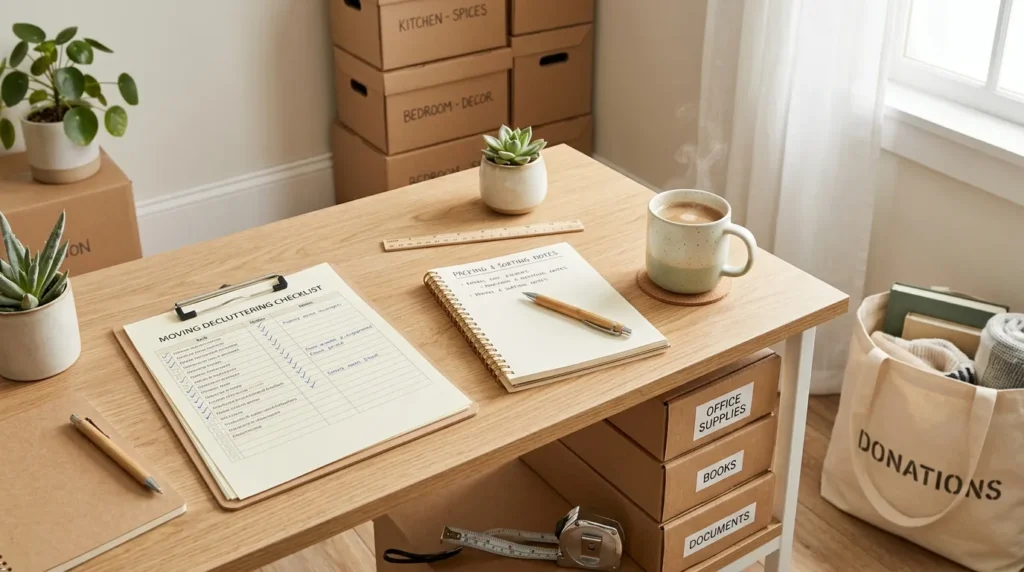
Create a basic moving declutter checklist using rooms or categories.
Write down your deadline and work backward. Give yourself enough time for selling, donating, recycling, and disposing of items before moving day.
Keep a few large bags or sturdy boxes available for outgoing belongings.
Start with a relatively easy area to build momentum. A bathroom cabinet, entryway drawer, or linen closet can provide a quick win.
Avoid setting unrealistic goals. Consistent progress over several days is usually more manageable than a single marathon decluttering session.
2. Work Room by Room
Quick Benefits
- Keeps the process organized
- Reduces overwhelm
- Makes progress visible
- Prevents repeated sorting
- Helps with packing later
Why It Works
A room-by-room system gives your decluttering project boundaries. When the entire house feels overwhelming, focusing on one physical space makes the task much more approachable.
Finish one category or room before moving to another whenever possible. This reduces the temptation to move piles around without actually making decisions.
It also helps you understand how much you own. When similar belongings are spread throughout multiple rooms, you may not realize how many duplicates you have.
For example, gather all extra towels before deciding how many you need. Collect cleaning supplies before determining what should stay. Seeing everything together often makes excess easier to identify.
How To Style It
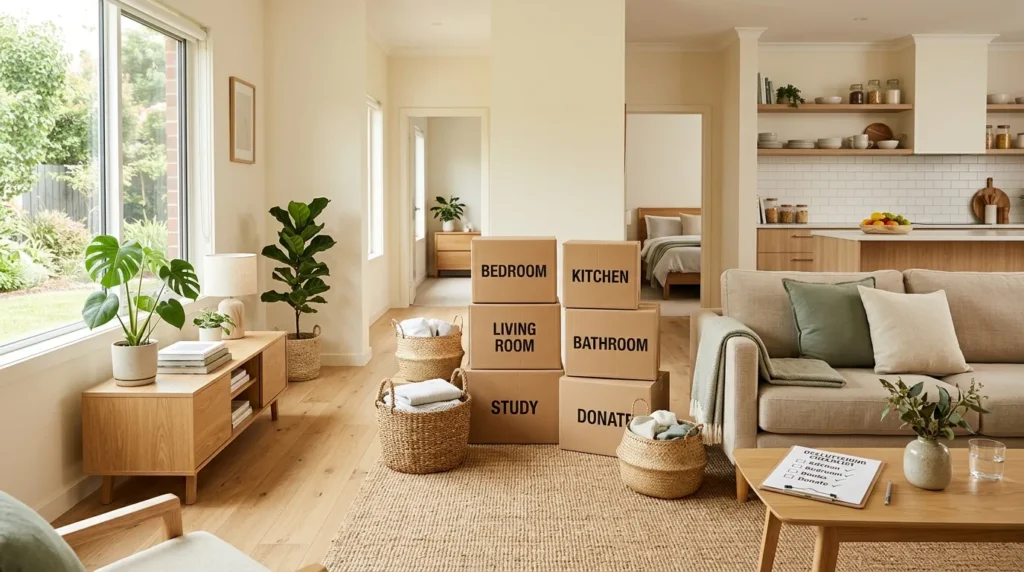
Create a simple sequence based on your home.
You might begin with the entryway, bathrooms, bedrooms, kitchen, living areas, storage spaces, and garage.
Don’t feel obligated to follow that exact order. Start with areas that are easiest or most urgent.
Within each room, work through one category at a time. For a bedroom, that might mean clothing first, then accessories, then bedside storage, then decor.
Keep completed areas finished. Once you’ve made a decision about something, don’t keep reopening the same box or drawer unless there’s a specific reason.
3. Clear the Easy Clutter
Quick Benefits
- Builds momentum quickly
- Creates immediate space
- Reduces packing volume
- Makes harder decisions easier
- Provides visible progress
Why It Works
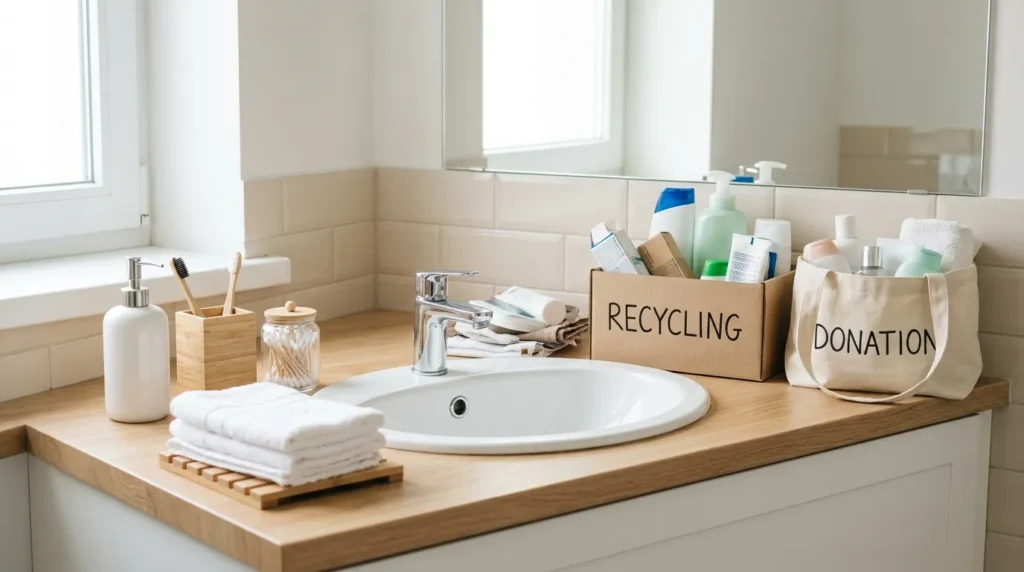
The easiest items to remove are usually things you already know you don’t need. Expired cosmetics, broken chargers, empty containers, worn-out household products, duplicate utensils, old magazines, and damaged items rarely require complicated decisions.
Starting here creates breathing room and helps you develop the habit of evaluating belongings.
The goal isn’t to get rid of as much as possible. It’s to identify things that no longer serve a useful purpose before they become moving boxes.
This first stage can also reveal storage areas you forgot existed. Once unnecessary items are gone, you may find that organizing the remaining belongings requires fewer containers and less furniture.
How To Style It
Walk through your home with a recycling bag, trash bag, and donation box.
Look for obvious candidates:
- Broken household items
- Expired products
- Duplicate accessories
- Old packaging
- Unused promotional items
- Worn-out textiles
- Damaged decor
- Outdated paperwork
Don’t spend ten minutes debating a clearly broken item that you haven’t repaired in years.
However, dispose of electronics, batteries, chemicals, medications, and other regulated materials according to appropriate local disposal guidance rather than simply placing everything in ordinary trash.
4. Edit Your Closet
Quick Benefits
- Reduces clothing boxes
- Makes unpacking easier
- Simplifies your wardrobe
- Reveals what you actually wear
- Creates easier access to favorites
Why It Works
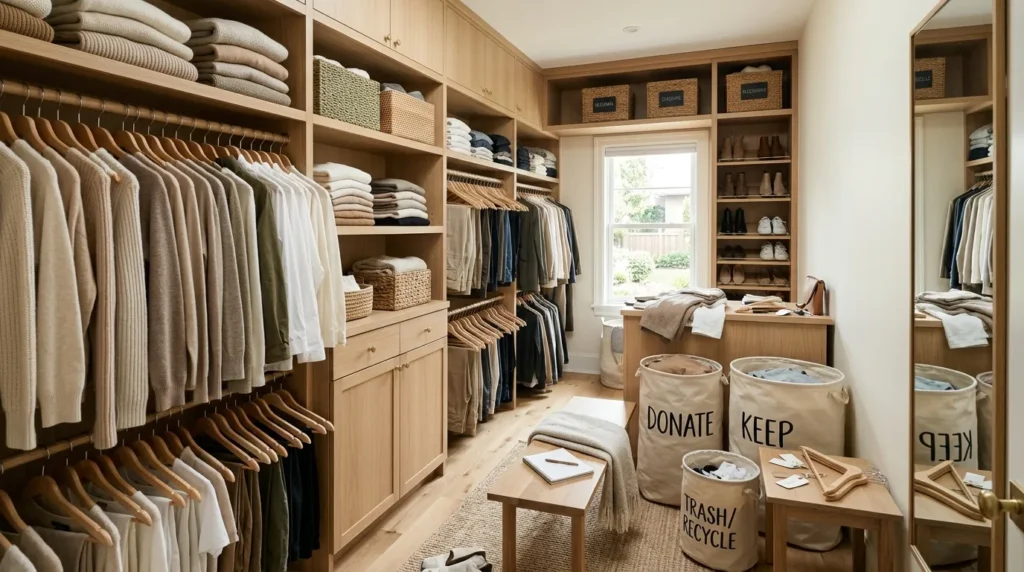
Clothing is one of the biggest sources of unnecessary moving volume. A wardrobe can contain pieces that haven’t been worn for years, don’t fit comfortably, require unrealistic alterations, or no longer suit your lifestyle.
Moving provides a useful opportunity to reconsider those items.
Instead of asking whether something is technically wearable, ask whether you actually choose it. Clothing that consistently stays at the back of the closet may not deserve a place in your next home.
Be especially careful with the “someday” category. Keeping one or two meaningful pieces is reasonable, but an entire wardrobe based on hypothetical future situations can quickly become clutter.
How To Style It
Take clothing out category by category.
Separate everyday clothes, formalwear, seasonal pieces, shoes, accessories, and outerwear.
For each item, consider:
- Does it fit comfortably?
- Have I worn it recently?
- Is it in good condition?
- Does it suit my current lifestyle?
- Would I buy it again today?
Create a small repair pile only for items you genuinely intend to repair.
Donate clean, usable clothing through appropriate local organizations or services.
Pack clothing you’ll keep according to category rather than randomly filling boxes. This makes unpacking considerably easier.
5. Simplify the Kitchen
Quick Benefits
- Reduces heavy moving boxes
- Frees cabinet space
- Removes duplicate tools
- Makes unpacking easier
- Helps you plan the new kitchen
Why It Works
Kitchens can be surprisingly difficult to declutter because many items seem useful in theory. A specialty gadget might have a specific purpose, but if you use it once every few years, it may not justify taking up valuable space.
Duplicates are another common issue. Multiple cutting boards, serving bowls, travel mugs, food containers, pans, utensils, and small appliances can quietly accumulate.
A move is an excellent time to compare what you own with how you actually cook and entertain.
How To Style It
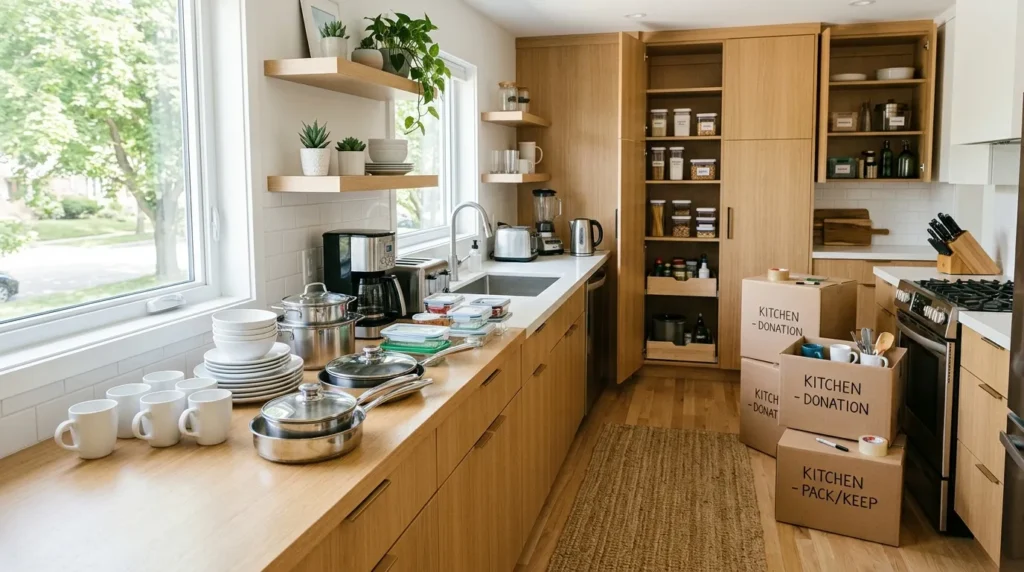
Open every cabinet and drawer rather than only looking at visible surfaces.
Group similar items together.
Check for:
- Duplicate utensils
- Chipped dishes
- Mismatched food containers
- Unused appliances
- Excess mugs
- Old water bottles
- Specialty gadgets
- Expired pantry items
- Extra serving pieces
Keep the items you regularly use and genuinely enjoy.
For food, check expiration dates and follow appropriate local guidance for disposing of expired or unwanted products.
When packing, group kitchen items logically. Clearly label fragile boxes and indicate which boxes contain items you’ll need immediately after moving.
6. Sort Paperwork
Quick Benefits
- Reduces unnecessary paper
- Protects important records
- Makes documents easier to find
- Creates less moving clutter
- Improves organization
Why It Works
Paper can be difficult to declutter because some documents have long-term importance while others become irrelevant quickly.
Moving is a useful opportunity to create one organized document system instead of transporting years of paperwork without reviewing it.
Important records should be handled carefully, and you should confirm retention requirements for financial, legal, tax, employment, property, medical, and other documents relevant to your circumstances.
Digital copies can be useful for records that are appropriate to digitize, but don’t assume every paper document can simply be discarded after scanning.
How To Style It
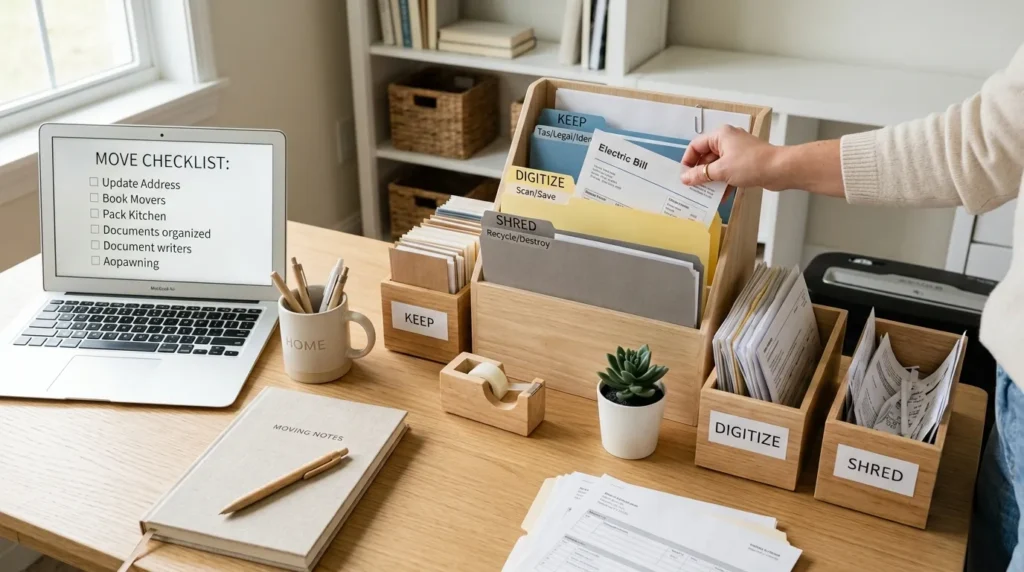
Create separate categories such as:
- Keep permanently
- Keep for a defined period
- Digitize where appropriate
- Shred
- Recycle
Use a secure method for sensitive documents containing personal or financial information.
Don’t throw confidential paperwork directly into ordinary recycling.
Store essential documents in a clearly labeled, secure location that stays with you rather than going into a general moving box.
7. Handle Sentimental Items
Quick Benefits
- Reduces emotional clutter
- Preserves meaningful memories
- Prevents rushed decisions
- Makes storage more manageable
- Creates intentional keepsakes
Why It Works
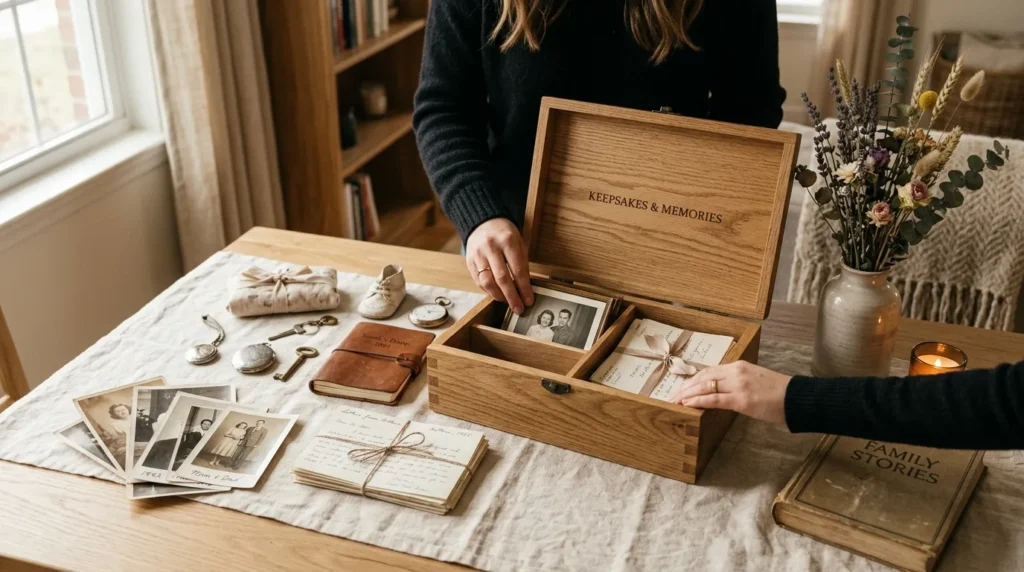
Sentimental belongings are often the hardest part of decluttering because their value isn’t practical. A ticket stub, childhood drawing, inherited dish, photograph, or old letter may represent a person or period of life that matters deeply.
You don’t need to become completely minimalist to create a more organized home.
Instead, focus on preserving the memories that genuinely matter. Keeping everything can sometimes make individual keepsakes less meaningful because they become buried among hundreds of other objects.
Give yourself more time with sentimental categories than you would with ordinary household clutter.
How To Style It
Create a dedicated sentimental box or container.
When considering an item, ask:
- Does this memory matter to me?
- Do I need the physical object to preserve that memory?
- Would a photograph or digital record be enough?
- Is there someone else in the family who would value it more?
Don’t force yourself to make difficult decisions when you’re exhausted.
If you’re uncertain, create a small “decide later” category with a specific review date rather than allowing an indefinite pile to follow you through the move.
8. Use Four Sorting Zones
Quick Benefits
- Simplifies decision-making
- Keeps categories clear
- Prevents mixed piles
- Speeds up the process
- Makes outgoing items easier to manage
Why It Works
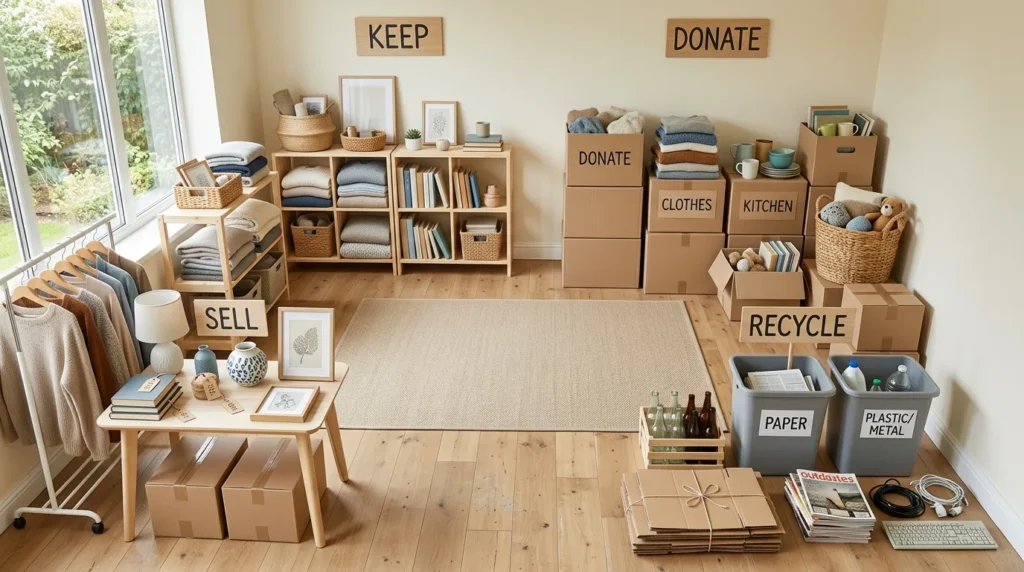
One of the simplest decluttering systems is to divide belongings into four categories: keep, donate, sell, and dispose or recycle appropriately.
Having defined destinations makes it easier to make decisions because you’re not simply creating random piles.
The important part is actually moving items out of your home. A donation pile sitting in the hallway for three weeks is still clutter.
Similarly, belongings intended for sale can become a problem if you never list them.
How To Style It
Use clearly labeled boxes, bags, or designated areas.
Keep: Items coming with you.
Donate: Clean, usable items you don’t want.
Sell: Items valuable enough to justify the effort of selling.
Dispose/Recycle: Items that are broken, unusable, or require an appropriate disposal route.
Add a fifth temporary category only if necessary: Decide Later.
Keep this category small and give it a firm deadline.
For anything you plan to sell, set a realistic listing date. If it doesn’t sell within your chosen timeframe, decide whether donating or another appropriate option makes more sense.
9. Sell and Donate Quickly
Quick Benefits
- Prevents outgoing clutter from returning
- Creates more space before moving
- Can recover some value
- Helps useful items find new homes
- Reduces last-minute stress
Why It Works
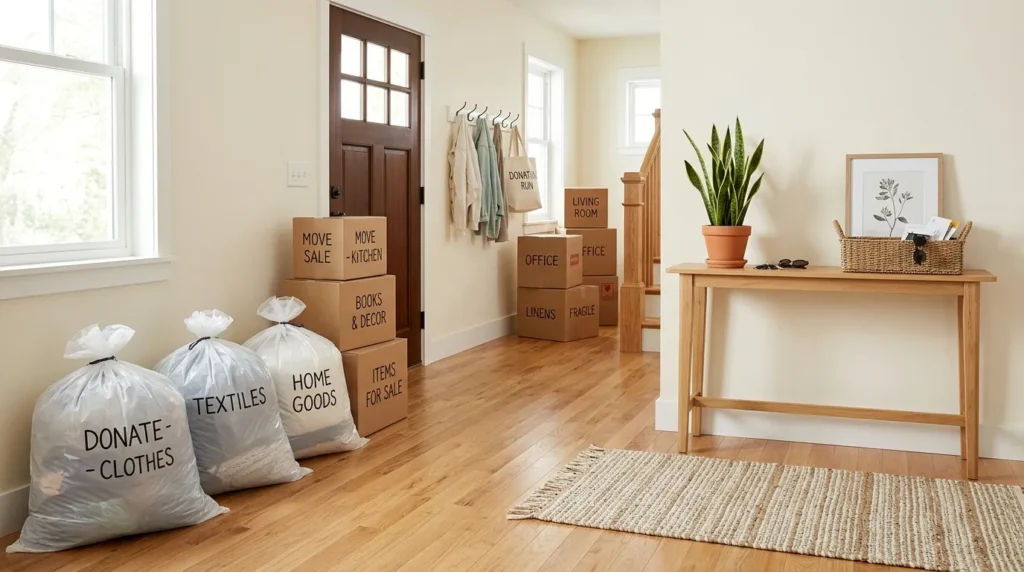
The period between deciding to move and actually moving can disappear surprisingly quickly. Items intended for donation or sale can sit around until suddenly you’re surrounded by boxes.
Set deadlines for outgoing belongings.
Selling everything may sound financially appealing, but your time has value too. A low-value item that requires extensive photography, messaging, negotiating, and arranging pickup may not be worth the effort.
Likewise, don’t donate items that are damaged, unsafe, or unsuitable for reuse simply because you want them out of your home.
How To Style It
Create a “departure date” for unwanted belongings.
For valuable items, use an appropriate local selling platform and set a reasonable price.
Bundle inexpensive related items where practical.
Schedule donation drop-offs or pickups before moving week.
Keep donation bags separate from packed belongings.
For items that cannot reasonably be donated, check whether your local recycling or waste service accepts them and whether special handling is required.
The objective is simple: nothing unwanted should still be sitting in your home on moving day.
10. Pack With Purpose
Quick Benefits
- Reduces unnecessary boxes
- Makes unpacking easier
- Creates a cleaner new home
- Saves time during the move
- Helps prioritize essentials
Why It Works
Packing should be the final stage of your decluttering process, not the beginning.
Once you’ve decided what belongs in your next home, pack those belongings intentionally.
Think about how you’ll use each item in the new space. If possible, group boxes by room and category so unpacking becomes a straightforward process.
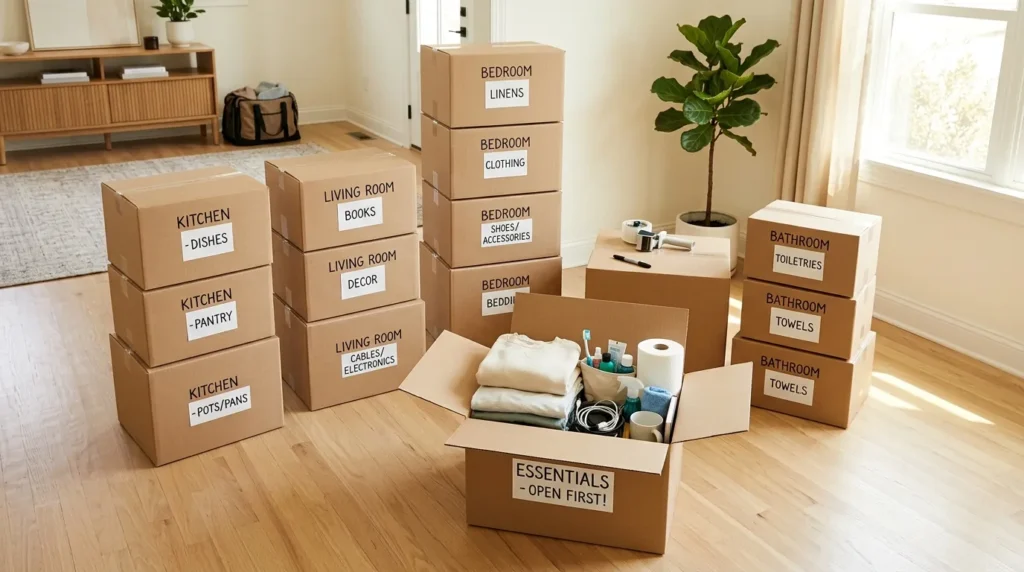
One simple trick I always suggest is creating an essentials box. It can contain the things you’ll need immediately after arriving, such as basic toiletries, chargers, medications or personal necessities you normally keep accessible, cleaning supplies, basic kitchen items, important documents, and a change of clothes.
The exact contents depend on your household, but the principle is universal: don’t bury your first-night necessities inside a dozen boxes.
How To Style It
Label boxes clearly on multiple sides.
Include the destination room and a short description of the contents.
Keep important documents, valuables, and essential personal items with you whenever practical.
Create a first-night or first-day box for immediate necessities.
Avoid filling boxes simply because there’s extra space. An empty corner in a box doesn’t mean you need another item.
Your goal is to arrive at your new home with belongings you actually want to unpack.
Frequently Asked Questions
When should I start decluttering before a big move?
Ideally, begin as soon as you know you’re moving. Starting several weeks or months ahead gives you time to sell valuable items, donate belongings, organize paperwork, and make thoughtful decisions without rushing. If your move is happening soon, prioritize obvious clutter and high-volume categories such as clothing, kitchenware, storage areas, and duplicate household items first.
What should I get rid of before moving?
Start with items you no longer use, broken belongings you aren’t realistically going to repair, duplicates, expired products, clothes you don’t wear, unnecessary paperwork, and decor that no longer suits your home. Also review bulky items that may not work in the new space. Avoid automatically moving something simply because you already own it.
Is it better to sell or donate unwanted items before moving?
It depends on the item’s value and how much time you have. Valuable furniture, electronics, tools, or collectibles may be worth selling. Lower-value belongings may be better donated if they’re clean and usable. Set a deadline for selling so unsold items don’t become last-minute moving clutter.
How do I declutter sentimental items before moving?
Give sentimental belongings more time than ordinary clutter. Gather similar items together, identify the pieces that genuinely carry meaning, and consider whether photographs or digital records can preserve some memories. Keep a manageable collection rather than trying to preserve every object connected to your past.
How many boxes should I expect after decluttering?
There is no universal number because household size and lifestyle vary significantly. The goal isn’t to reach a specific box count. Instead, focus on removing belongings you don’t need before packing. Once you’ve decluttered, pack only the items that have a clear purpose, meaningful value, or appropriate place in your next home.
How can I avoid bringing clutter into my new home?
Make every item earn its place before it goes into a moving box. Use clear keep, donate, sell, and dispose categories. Label boxes by room and contents, and don’t pack questionable items just because you’re running out of time. A move is much easier when the decision happens before the box is sealed.
What should I pack separately for moving day?
Keep essential personal items, important documents, chargers, basic toiletries, necessary medications or personal necessities, a change of clothes, and immediate household basics accessible. An essentials box can help you avoid opening numerous boxes after arriving. Keep valuables and important documents in a secure location rather than burying them in general moving boxes.
Conclusion
Decluttering before a big move is about more than reducing the number of boxes. It’s an opportunity to decide what belongs in the home you’re moving toward.
The easiest approach is to start early, work room by room, and make decisions before packing begins. Begin with obvious clutter, then move into more complicated categories such as clothing, kitchenware, paperwork, and sentimental belongings.
Don’t feel pressured to remove everything that isn’t used every day. A home should contain things that support your lifestyle, bring meaning, or serve a useful purpose. The goal is intentional ownership, not an empty house.
Use clear sorting categories, give selling and donation piles firm deadlines, and dispose of unsuitable items responsibly. Most importantly, don’t let undecided belongings automatically become moving boxes.
When packing finally begins, every box should contain things you’ve already chosen to bring with you.
That mindset can make the transition feel much lighter. Instead of arriving at your new home surrounded by the same clutter you were trying to escape, you’ll have a cleaner starting point and a better idea of how you want the new space to function.
Start with one drawer, one shelf, or one closet today. Small decisions add up quickly, and by moving day, those small efforts can make a surprisingly big difference.
Related Articles
- How to Organize Your Home Room by Room
- 10 Small Space Organization Ideas That Actually Work
- 10 Easy Home Organization Ideas for Busy Families
- How to Declutter Your Bedroom Without Feeling Overwhelmed
- 10 Simple Storage Ideas for a More Organized Home