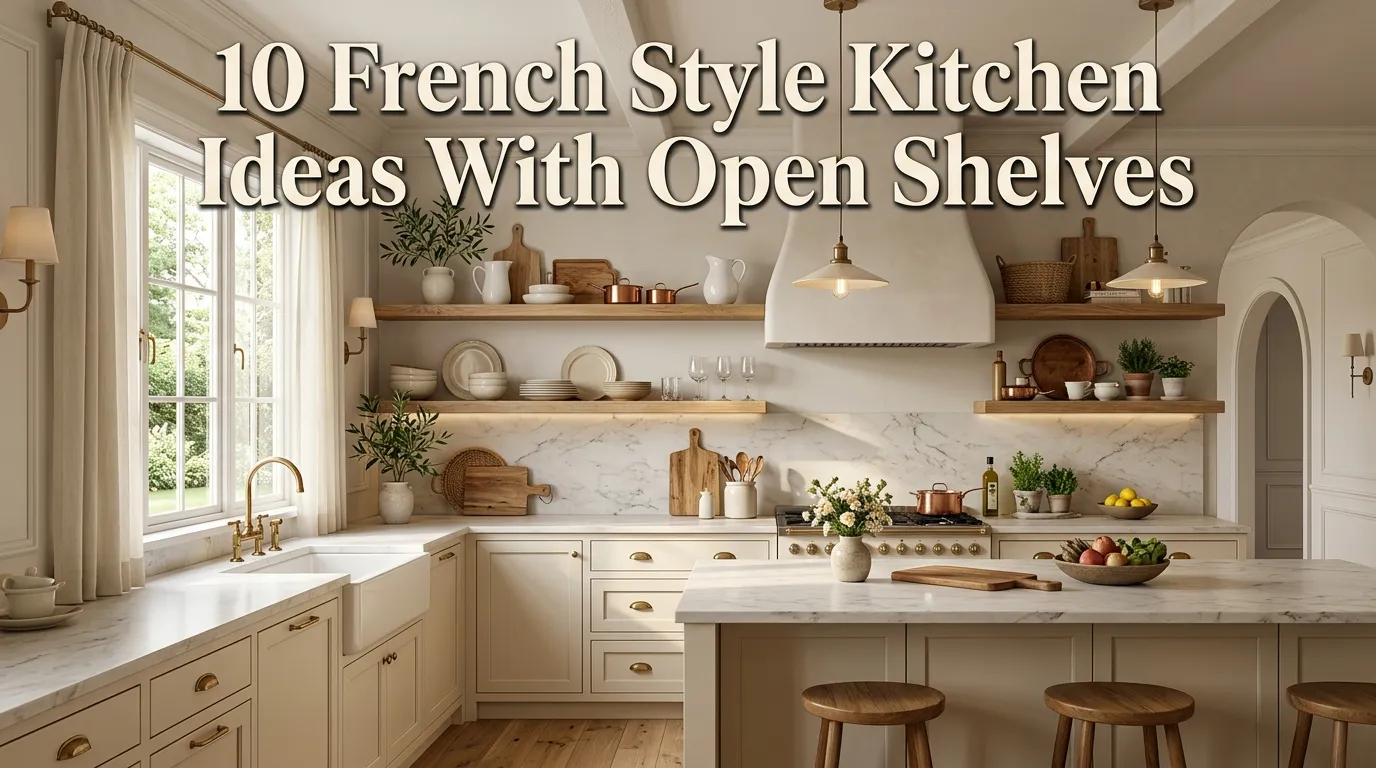
10 French Style Kitchen Ideas With Open Shelves
French-inspired kitchens have a particular way of feeling both elegant and lived-in. They can look polished without appearing overly coordinated, and open shelving fits naturally into that balance. Instead of hiding every dish and serving piece behind closed doors, shelves allow everyday objects to become part of the room’s character.
The beauty of this style isn’t about recreating a formal Parisian kitchen piece by piece. It’s about combining timeless materials, soft colors, vintage touches, and practical details in a way that feels collected over time. Open shelves can make that look even more approachable because they give you a place to display ceramics, glassware, cookbooks, cutting boards, and small pieces you actually use.
One thing that works especially well in a French-style kitchen is restraint. You don’t need every shelf packed with decorative objects. A few stacks of white plates, a ceramic pitcher, a wooden board, and a small vase of greenery can create much more impact when they have room to breathe.
Open shelving can also make a kitchen feel lighter. This is particularly helpful when upper cabinets make a small kitchen feel visually heavy. Replacing some cabinetry with shelves can open the wall while still giving you useful storage.
The ideas below explore different ways to combine French kitchen character with open shelving, from warm wood and vintage ceramics to marble backsplashes and brass accents. Whether you’re planning a renovation or simply want to refresh your existing kitchen, these approaches can help you create a space that feels timeless, welcoming, and beautifully practical.
Table of Contents
1. Warm Wood Shelves
Use natural wood shelving to bring warmth and character to a classic French-inspired kitchen.
2. Creamy Neutral Palette
Pair open shelves with soft whites, creams, and warm neutrals for a relaxed European atmosphere.
3. Vintage Ceramic Display
Let everyday plates, pitchers, and serving pieces become part of the kitchen’s decoration.
4. Marble Shelf Backdrop
Combine open shelving with marble or marble-look surfaces for an elegant yet practical focal point.
5. Brass Shelf Brackets
Add subtle metallic detail with brass hardware that complements traditional French kitchen finishes.
6. Rustic Farmhouse Shelves
Blend French country character with reclaimed-looking wood and simple handcrafted accessories.
7. Symmetrical Shelf Styling
Use balanced arrangements to create an organized look without losing the relaxed French feeling.
8. Open Shelves With Cabinets
Combine shelving and closed storage to achieve both visual lightness and everyday practicality.
9. Botanical Kitchen Details
Bring natural softness to open shelving with herbs, flowers, and small potted plants.
10. Collected European Charm
Mix old and new pieces to create an authentic, personal kitchen that feels gathered rather than decorated.
1. Warm Wood Shelves
Quick Benefits
- Adds warmth to pale kitchens
- Creates natural contrast
- Works with modern or traditional cabinetry
- Makes everyday dishes feel decorative
- Introduces an organic material
Why It Works
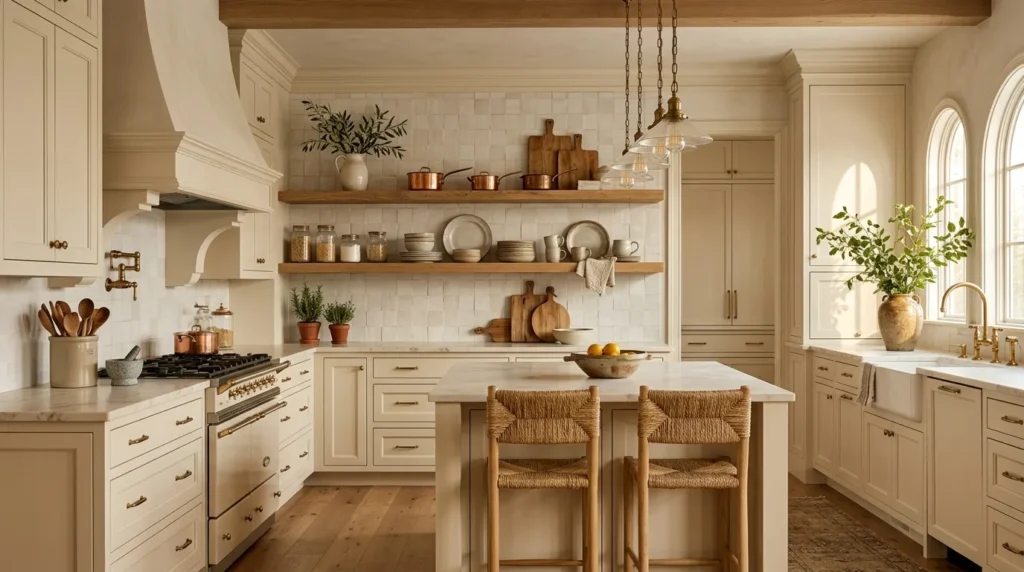
Natural wood is one of the easiest ways to bring warmth into a French-inspired kitchen. Many French-style interiors balance light painted surfaces with aged or natural materials, and wood shelving provides exactly that contrast.
Instead of looking perfectly new, shelves with visible grain and a slightly softened finish can give the kitchen a more established feeling. This works particularly well against cream tile, plaster-style walls, painted cabinets, or stone backsplashes.
Wood also helps prevent an all-white kitchen from feeling too stark. A few warm shelves can connect the cabinetry to cutting boards, wooden utensils, woven baskets, and other natural accessories.
The goal isn’t necessarily to make the shelves look rustic. A clean, simple oak shelf can feel just as elegant as a reclaimed board when paired with refined ceramics and understated hardware.
How To Style It
Choose shelves that are thick enough to look substantial against the wall. Natural oak, walnut, reclaimed wood, or a lightly stained timber can all work depending on your cabinetry.
Keep the styling practical. Place everyday white plates in a small stack, add a ceramic pitcher, lean a wooden cutting board against the wall, and finish with one or two small decorative pieces.
Leave sections of the shelf empty so the arrangement doesn’t become visually crowded.
If your kitchen already has dark wood floors or cabinets, choose a shelf finish that complements rather than competes with them.
For a more traditional appearance, pair the wood with brass brackets. For a cleaner modern French look, use concealed supports or slim metal hardware.
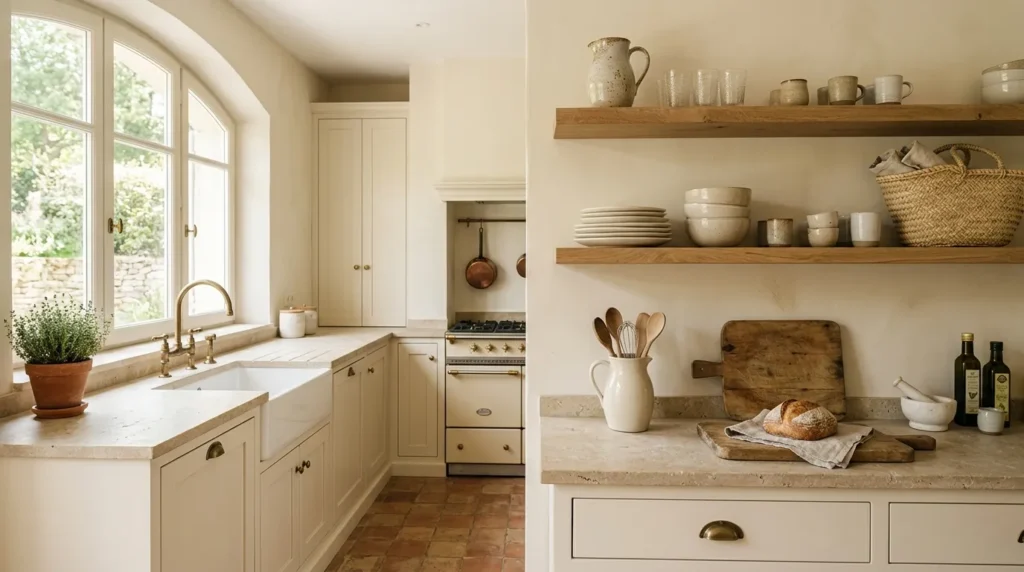
2. Creamy Neutral Palette
Quick Benefits
- Creates a soft European atmosphere
- Makes shelves feel cohesive
- Works with many kitchen styles
- Keeps the room visually calm
- Provides a timeless foundation
Why It Works
French kitchens often feel comfortable because their colors are softer than the stark whites commonly associated with contemporary interiors. Cream, ivory, warm white, beige, pale taupe, and muted gray can create a more layered appearance.
Open shelves are particularly effective in this palette because the objects displayed on them become subtle variations of the same color family.
Instead of trying to match every item, choose pieces that share a warm undertone. Cream ceramics can sit beside pale wood, woven baskets, aged brass, and soft green plants without creating visual clutter.
This approach is especially helpful if you want a kitchen that feels elegant but still practical. The neutral background allows the texture of the materials to become the main feature.
How To Style It
Start with a warm wall color or backsplash. Soft cream cabinets paired with slightly lighter walls can create depth without strong contrast.
On the shelves, use ivory plates, beige bowls, stoneware mugs, natural wood boards, and muted linen textiles.
Add small touches of brass or aged metal through hardware and accessories.
Avoid using too many shades of bright white. Combining slightly different warm neutrals usually feels more natural.
If the kitchen has stainless-steel appliances, repeat a little of that cooler tone elsewhere rather than trying to hide it. The contrast between warm cabinetry and practical appliances can actually make the room feel more authentic.
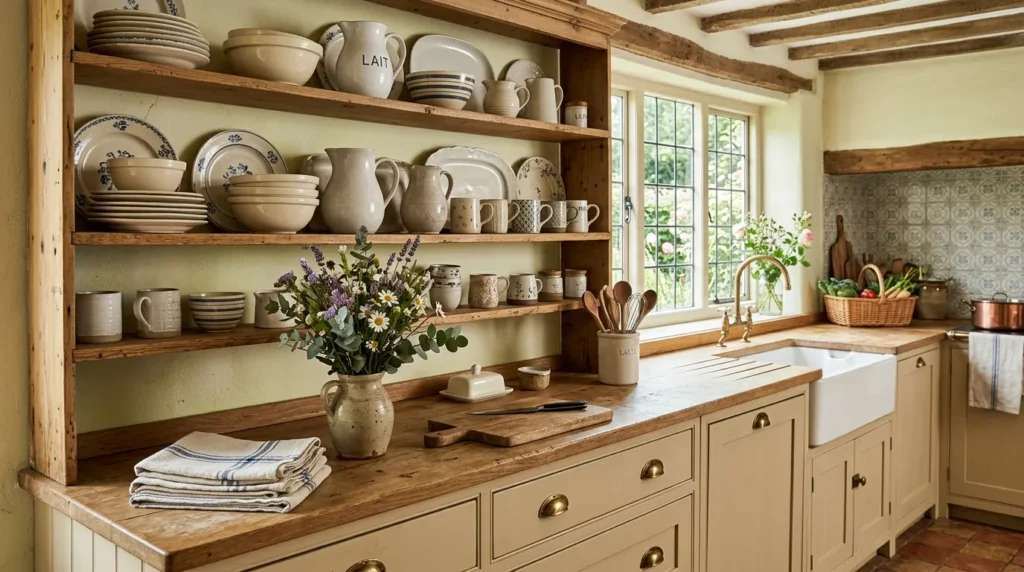
3. Vintage Ceramic Display
Quick Benefits
- Adds personality
- Makes shelves feel collected
- Creates a traditional French atmosphere
- Allows useful pieces to become decor
- Works with thrifted or inherited items
Why It Works
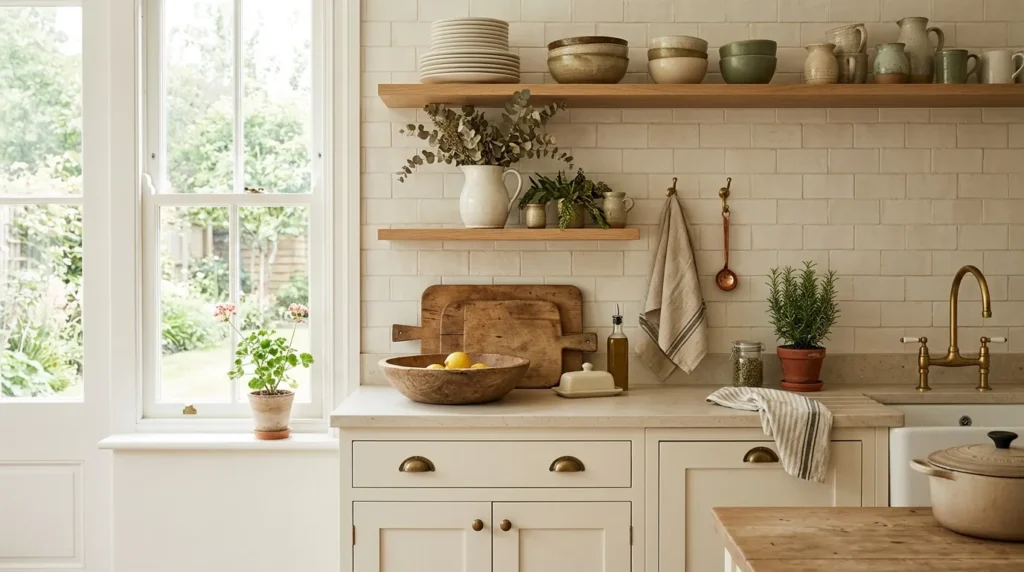
A French-style kitchen rarely needs to look as though every item was purchased at the same time. Vintage ceramics can give open shelving the sense of history that makes the space feel lived-in.
Old-looking plates, stoneware pitchers, patterned bowls, café-style cups, and serving platters can all add character. They don’t have to be genuinely antique, either. New pieces with handmade finishes or traditional shapes can create a similar effect.
The important thing is variation. A shelf filled entirely with identical plates can feel like a store display. Mixing shapes and subtle textures makes the arrangement feel more personal.
How To Style It
Begin with a few larger pieces. A ceramic pitcher or serving platter can act as an anchor, while smaller bowls and cups fill in around it.
Stack plates rather than standing every item vertically. This makes the shelf more functional and creates natural horizontal lines.
Use a restrained color palette. Cream, white, pale blue, muted green, soft gray, and terracotta can work beautifully together.
If you find a vintage piece you love, don’t worry if it isn’t perfectly coordinated with everything else. A little variation is part of the charm.
Keep frequently used items within easy reach and place more delicate decorative pieces higher or farther back.
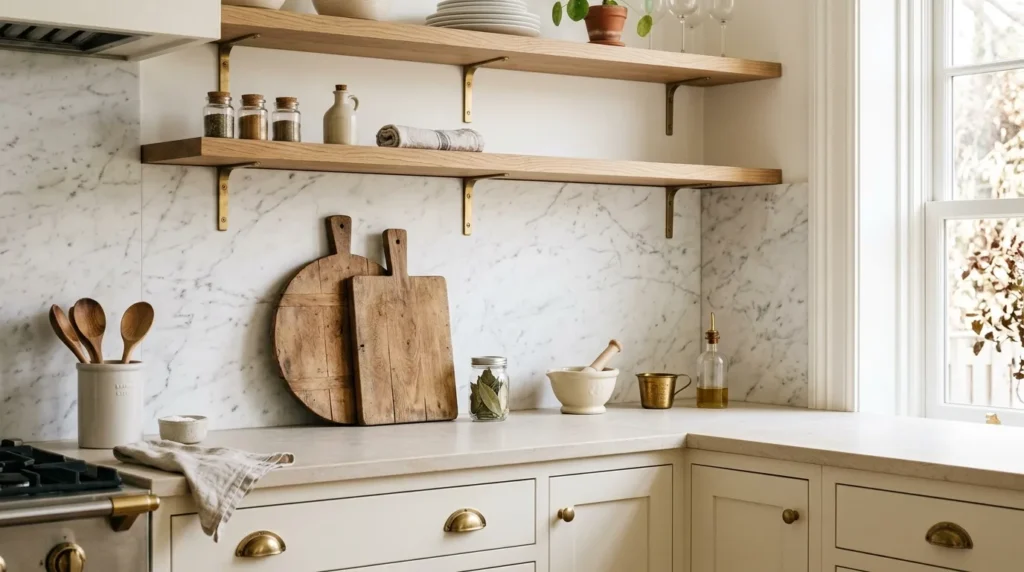
4. Marble Shelf Backdrop
Quick Benefits
- Creates an elegant focal point
- Adds visual depth
- Complements brass and wood
- Works with classic kitchen designs
- Makes simple shelves feel sophisticated
Why It Works
Marble and French-inspired kitchens are a natural pairing. The material has been used in European kitchens for generations because it combines beauty with practical utility.
Using marble behind open shelves creates a strong backdrop without requiring elaborate decoration. The veining provides subtle movement, while the shelves introduce warmth and dimension.
If genuine marble isn’t appropriate for your budget or maintenance preferences, marble-look porcelain or other suitable surfaces can provide a similar visual effect.
The key is allowing the material to remain visible. Overloading the shelves can hide the very feature that makes the wall interesting.
How To Style It
Choose simple shelves against a marble backsplash rather than competing with the stone using overly decorative brackets.
White or cream ceramics work beautifully with light marble, while natural wood adds warmth to cooler stone.
Use brass or aged-metal hardware to reinforce the classic European feeling.
Keep the shelf arrangement relatively sparse. A few carefully chosen pieces will allow the marble veining to remain visible.
If you have a dramatic stone pattern, simplify the accessories. If the marble is subtle, you can introduce more texture through ceramics, wood, and woven materials.
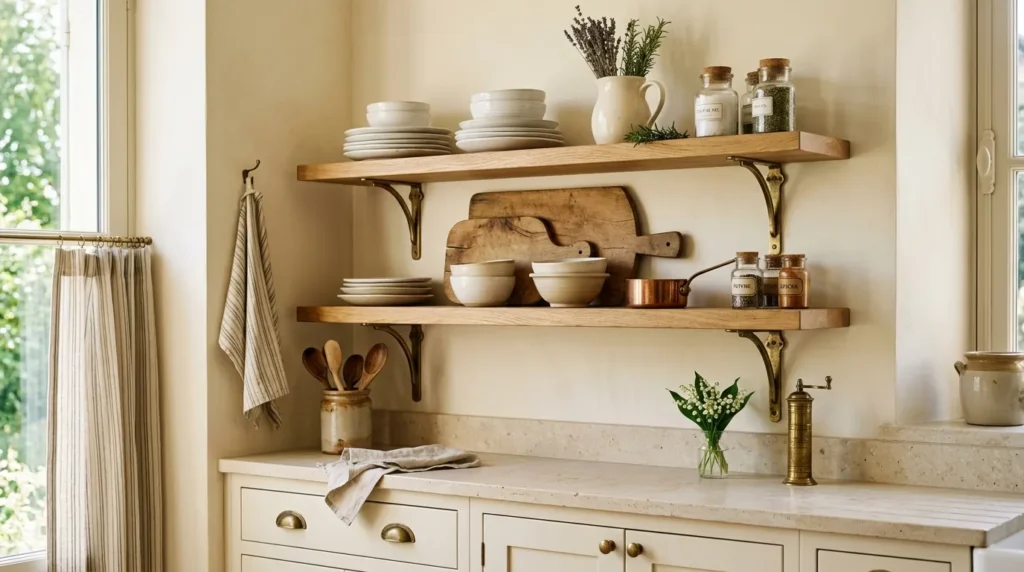
5. Brass Shelf Brackets
Quick Benefits
- Adds subtle elegance
- Works with traditional hardware
- Introduces warm metallic detail
- Helps define open shelving
- Pairs beautifully with cream and wood
Why It Works
Small hardware choices can have a surprisingly large influence on the overall character of a kitchen. Brass brackets bring warmth and a traditional European quality to open shelves without requiring major changes.
The finish is particularly effective with cream cabinetry, natural wood, marble, painted walls, and vintage ceramics.
Aged or unlacquered brass can look especially appropriate in a French-inspired kitchen because it develops character over time. Polished brass can work too, but a softer finish usually feels less formal.
How To Style It
Use brackets that are proportional to the shelf depth and thickness. Decorative brackets can make a stronger statement, while simple L-shaped or streamlined supports provide a quieter look.
Repeat the brass finish elsewhere in the kitchen through cabinet pulls, faucets, lighting, or small accessories.
Don’t worry if every brass element isn’t an exact match. Slight differences can actually contribute to a collected appearance.
Pair the shelves with warm wood, cream ceramics, and natural textiles for a classic French country feeling.
If the kitchen already contains several metallic finishes, keep the shelving hardware simple so it doesn’t compete.
6. Rustic Farmhouse Shelves
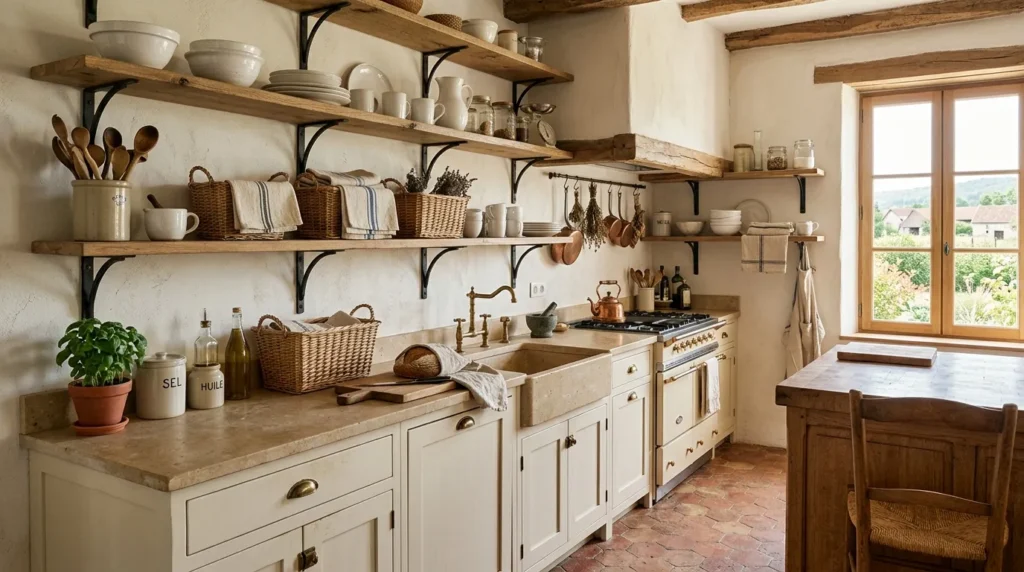
Quick Benefits
- Creates a relaxed French country mood
- Adds natural texture
- Works with older-looking cabinetry
- Makes the kitchen feel welcoming
- Can be achieved on different budgets
Why It Works
French country style and farmhouse design share an appreciation for natural materials, useful objects, and comfortable imperfections. Open shelving provides a natural bridge between the two.
The rustic approach doesn’t mean everything needs to look distressed. A slightly irregular wood grain, handmade ceramics, linen, and woven storage can provide enough texture without making the kitchen feel themed.
This style is especially appealing if you want the room to feel like a place where cooking and gathering happen every day.
How To Style It
Choose medium-toned or lightly weathered wood shelves and pair them with simple iron or brass brackets.
Display white stoneware, wooden cutting boards, linen towels, woven baskets, and a few vintage-style kitchen tools.
A small ceramic crock filled with wooden utensils can be both useful and decorative.
Keep the color palette grounded in cream, warm white, tan, muted green, and natural brown.
Avoid excessive farmhouse signs or novelty decorations. The French-inspired feeling comes more from materials and restraint than from obvious themed accessories.
7. Symmetrical Shelf Styling
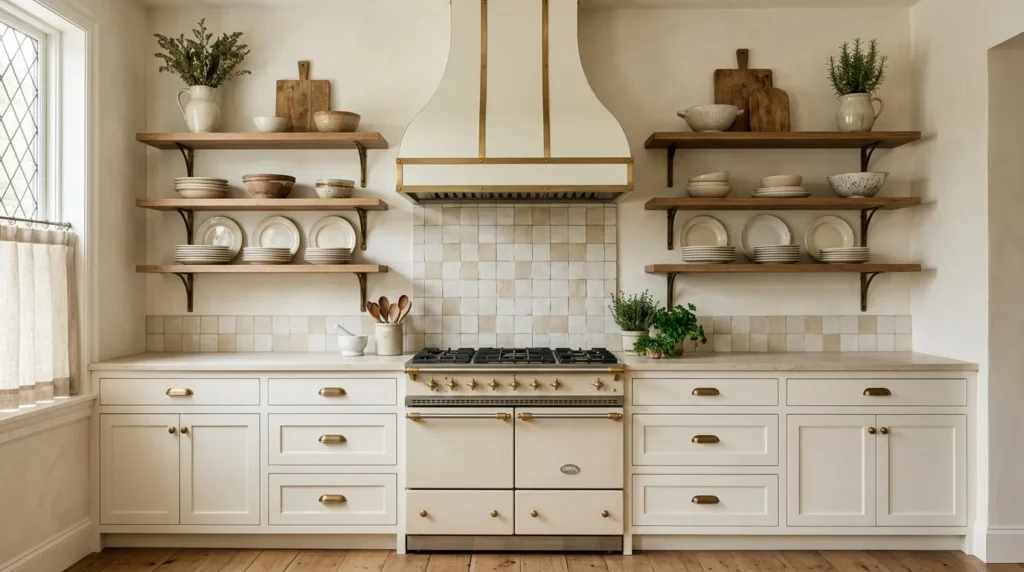
Quick Benefits
- Creates visual balance
- Works well above counters
- Makes open shelving feel organized
- Easy to maintain
- Complements traditional kitchen architecture
Why It Works
Symmetry is useful when you want open shelves to feel polished rather than random. French-inspired kitchens often combine relaxed materials with architectural balance, and symmetrical shelving can reinforce that structure.
Matching shelves on either side of a range hood or centered above a countertop can create a strong focal point.
The styling doesn’t have to be identical on both sides. What matters is visual weight. One side might have a stack of plates and a pitcher, while the other has bowls and a larger cutting board.
How To Style It
Start by creating a clear central point. A range hood, window, or piece of artwork can become the anchor.
Install matching shelves on either side when the architecture allows it.
Keep the largest objects toward the lower shelves or toward the back, then layer smaller pieces around them.
Use repeated materials to connect the sides. For example, include wood on both sides and repeat the same ceramic finish.
Don’t force perfect symmetry into an irregular kitchen. Sometimes balanced asymmetry looks more natural and is easier to live with.
8. Open Shelves With Cabinets
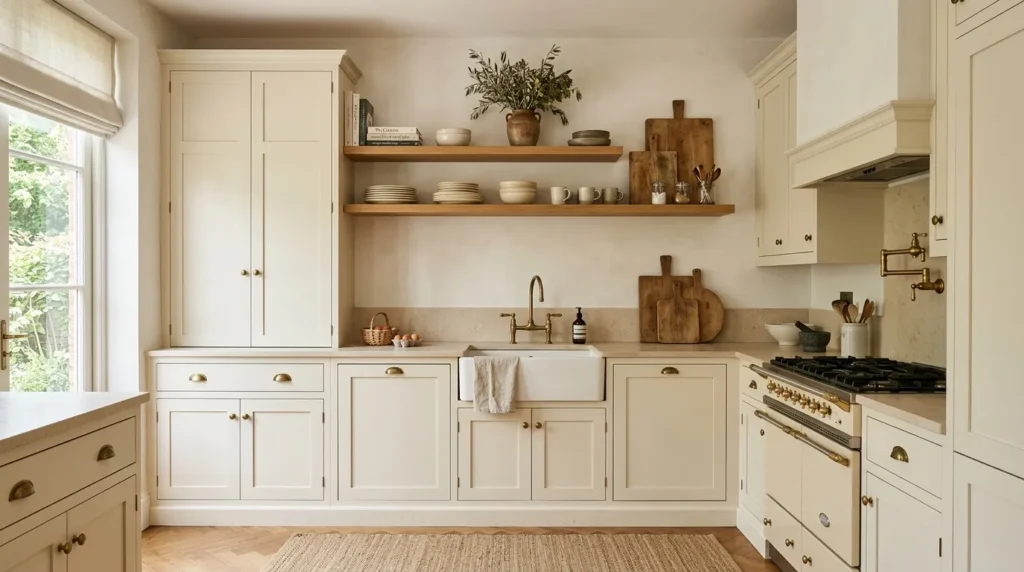
Quick Benefits
- Combines display and concealed storage
- Keeps frequently used items accessible
- Reduces visual heaviness
- Provides practical storage
- Works well in busy kitchens
Why It Works
One concern with open shelving is that it can look beautiful in photographs but become impractical if every kitchen item has to be displayed. Combining open shelves with closed cabinets solves much of that problem.
Keep everyday or attractive pieces on the shelves and place less decorative, bulkier, or rarely used items behind cabinet doors.
This approach gives you the visual openness of shelving without sacrificing storage.
It can also make a kitchen feel less top-heavy. A wall of upper cabinets can sometimes dominate a smaller room, while replacing a section with shelves creates breathing room.
How To Style It
Use open shelves strategically rather than removing all upper cabinetry.
For example, install two shelves beside a range hood while keeping cabinets on either side. Alternatively, use shelves on one wall and full-height storage elsewhere.
Display the items you reach for often: plates, mugs, glasses, bowls, and cookbooks.
Keep appliances, food packaging, cleaning supplies, and miscellaneous items behind closed doors.
This balance is particularly useful for families and busy households because the kitchen can still look composed without requiring constant styling.
9. Botanical Kitchen Details
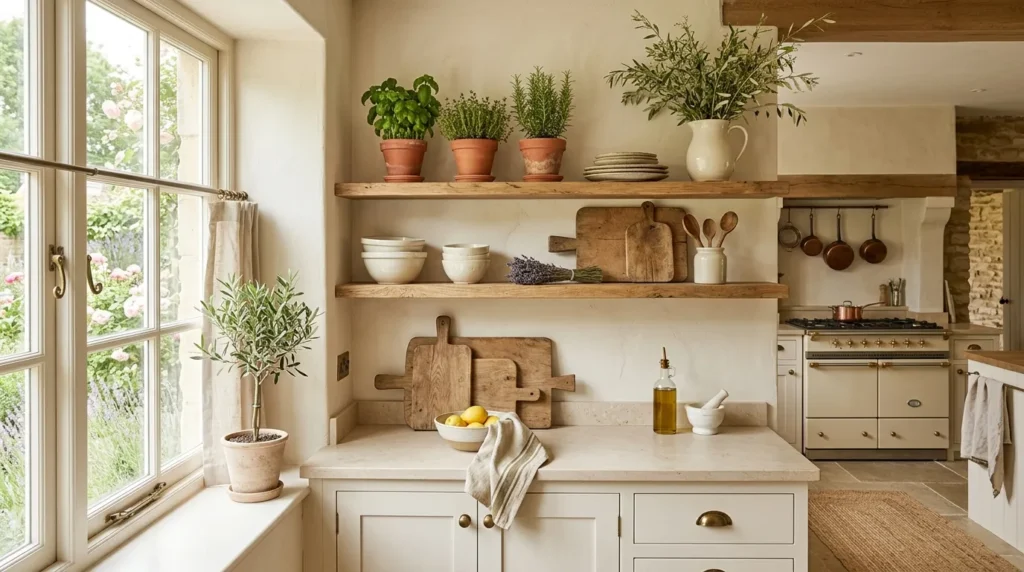
Quick Benefits
- Adds natural color
- Softens hard kitchen surfaces
- Makes shelves feel fresh
- Works with neutral palettes
- Provides practical herb-growing opportunities
Why It Works
Greenery brings life to open shelving and works naturally with French-inspired materials such as wood, stone, ceramic, and linen.
A small pot of rosemary, thyme, or basil can be both attractive and useful. If your kitchen receives enough suitable light, herbs can become part of the shelf arrangement rather than something hidden away.
Fresh flowers in a ceramic pitcher can create a simple focal point, while a small trailing plant can soften the straight line of a shelf.
The trick is keeping the greenery intentional. You don’t need plants on every shelf.
How To Style It
Choose one or two shelves for botanical details rather than filling the entire arrangement with greenery.
A small herb pot can sit beside stacked bowls, while a ceramic pitcher filled with seasonal branches can anchor a higher shelf.
Use natural containers such as terracotta, stoneware, or simple ceramic pots.
Repeat green tones through a tea towel, bowl, or small piece of artwork if you want the kitchen to feel cohesive.
Make sure plants receive the light and care they need. If your shelves are far from a suitable window, use decorative branches or high-quality artificial greenery instead of forcing live plants into unsuitable conditions.
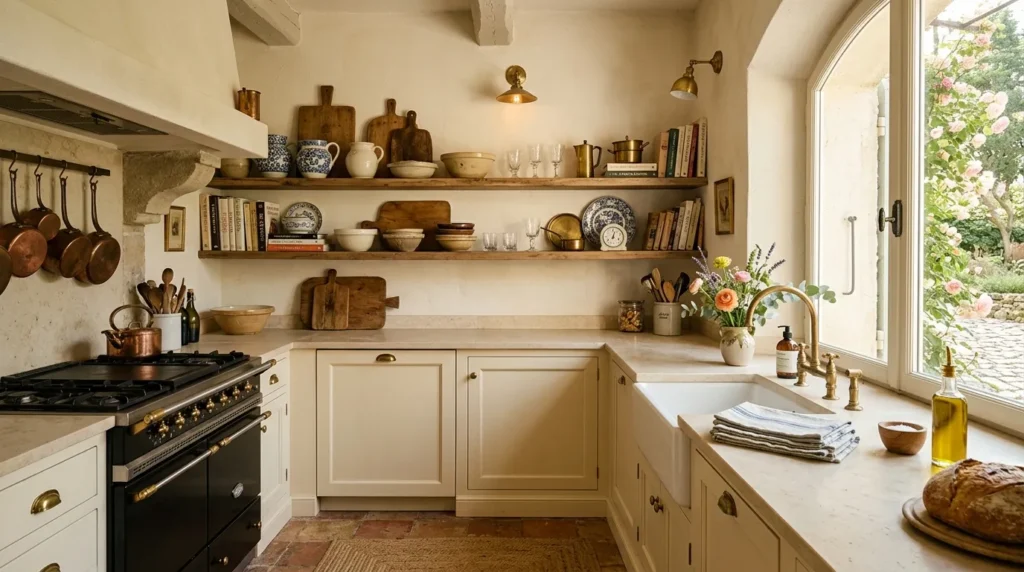
10. Collected European Charm
Quick Benefits
- Creates a personal kitchen
- Blends old and new pieces
- Avoids a showroom appearance
- Works with many French-inspired styles
- Allows the decor to evolve naturally
Why It Works
Perhaps the most appealing quality of French-style kitchens is that they rarely feel overly decorated. They often appear as though useful objects and beautiful pieces have been collected gradually.
Open shelves are perfect for recreating that feeling because they allow you to mix new dinnerware with vintage finds, cookbooks, handmade ceramics, wood boards, glassware, and objects with personal meaning.
The result should feel comfortable rather than carefully staged.
A mistake many homeowners make is trying to purchase an entire set of accessories at once. A more natural-looking kitchen usually develops over time.
How To Style It
Start with the things you already use and love. Place your favorite plates, mugs, cutting boards, and serving pieces on the shelves.
Then add one or two pieces with history or character. This could be a vintage ceramic pitcher, an old wooden board, a framed recipe, or a handmade bowl.
Mix materials rather than using only ceramics. Wood, glass, metal, linen, and woven fibers create a richer visual experience.
Keep a consistent general palette so the different objects don’t feel disconnected.
Leave some empty space. The goal is a kitchen that looks lived in, not a shelf that looks like a collection display.
Frequently Asked Questions
What should you put on open shelves in a French-style kitchen?
Choose a combination of useful and decorative pieces such as ceramic plates, bowls, mugs, glassware, wooden cutting boards, pitchers, cookbooks, linen towels, and small plants. Keep the palette cohesive and avoid filling every inch. A few larger pieces mixed with smaller everyday items usually create a more natural, collected appearance.
Are open shelves practical in a kitchen?
Open shelves can be practical when used selectively. They’re especially useful for items you use frequently, such as plates, bowls, mugs, and glasses. Less attractive or rarely used kitchen supplies can remain inside closed cabinets. The key is placing shelves where they’re easy to access and keeping the display simple enough to maintain.
What wood looks best with French kitchen cabinets?
Light to medium natural woods such as oak can work beautifully with cream, white, taupe, and muted painted cabinetry. Warmer walnut can create more contrast and a slightly richer appearance. The best choice depends on your flooring, cabinets, countertops, and existing wood tones. Try to coordinate undertones rather than matching every wood surface exactly.
How do you make open shelves look elegant?
Start with fewer items and give them breathing room. Use a consistent color palette, combine different heights and textures, and include a few larger anchor pieces. Repeating materials such as natural wood, cream ceramics, and brass can create cohesion. Avoid placing every kitchen item on display; closed cabinets can hide the pieces that create visual clutter.
How many open shelves should a kitchen have?
There isn’t a fixed number. Two or three shelves are often enough to create a useful display without overwhelming the wall. In a smaller kitchen, one or two long shelves may be more effective. Consider the wall size, cabinet layout, ceiling height, and how much storage you actually need before deciding.
Do open shelves make a kitchen look bigger?
They can make a kitchen feel visually lighter because they take up less visual mass than a continuous wall of upper cabinets. However, shelves that are heavily packed can create the opposite effect. Keeping the display relatively sparse and using light colors can help preserve the sense of openness.
What colors work best for a French country kitchen?
Warm white, cream, beige, pale gray, muted blue, soft green, natural wood, and gentle terracotta are all useful choices. The best French-inspired palettes tend to feel softened rather than extremely saturated. Combining several related tones creates the layered, relaxed appearance associated with French country interiors.
Conclusion
French-style kitchens are appealing because they balance beauty with everyday life. They don’t need to look perfect to feel elegant, and open shelving can reinforce that quality beautifully.
The key is to think beyond decoration. Your shelves can hold the plates you use every morning, the cutting board you reach for when cooking dinner, a ceramic pitcher from a favorite shop, or a small pot of herbs growing near the window. Those practical details are often what make a kitchen feel authentic.
If your kitchen feels too heavy, replacing a small section of upper cabinetry with open shelves can introduce visual breathing room. If the room feels cold, warm wood, cream ceramics, brass hardware, and natural textiles can add softness. If the shelves feel chaotic, edit the display rather than adding more storage.
You don’t need to copy a particular French kitchen. Instead, borrow the principles: natural materials, restrained colors, useful objects, gentle contrast, and a sense of history.
Start with one wall or one shelf. Choose a few pieces you genuinely enjoy using, leave some space around them, and let the arrangement evolve.
The most beautiful French-inspired kitchen isn’t the one with the most decoration. It’s the one that feels welcoming enough to cook in, practical enough to live in, and personal enough to feel like your own.
Related Articles
- 10 French Country Kitchen Ideas for a Timeless Home
- 10 Cozy Kitchen Ideas With Warm and Inviting Details
- 10 Small Kitchen Ideas That Make the Most of Limited Space
- 10 Kitchen Countertop Decor Ideas for a Beautiful Everyday Look
- 10 Modern Kitchen Ideas With Warm Natural Materials